Baseline CNN
SimpleCNN is the from-scratch reference: if a pretrained model cannot beat it, transfer learning is not helping.
Key results
_facts/astrovision/FACTS_INDEX.md §3 and shown when hovering over a number.Architecture
Input (3, 256, 256)
  conv_block(3→32)    2×[Conv3×3 · BN · ReLU] · MaxPool · Dropout2d(0.1)   → 128×128
  conv_block(32→64)   idem                                                  →  64×64
  conv_block(64→128)  idem, Dropout2d(0.2)                                  →  32×32
  Conv3×3(128→256) · BN · ReLU · MaxPool                                    →  16×16
  AdaptiveAvgPool → Linear(256→256) · ReLU · Dropout(0.4) → Linear(256→10)
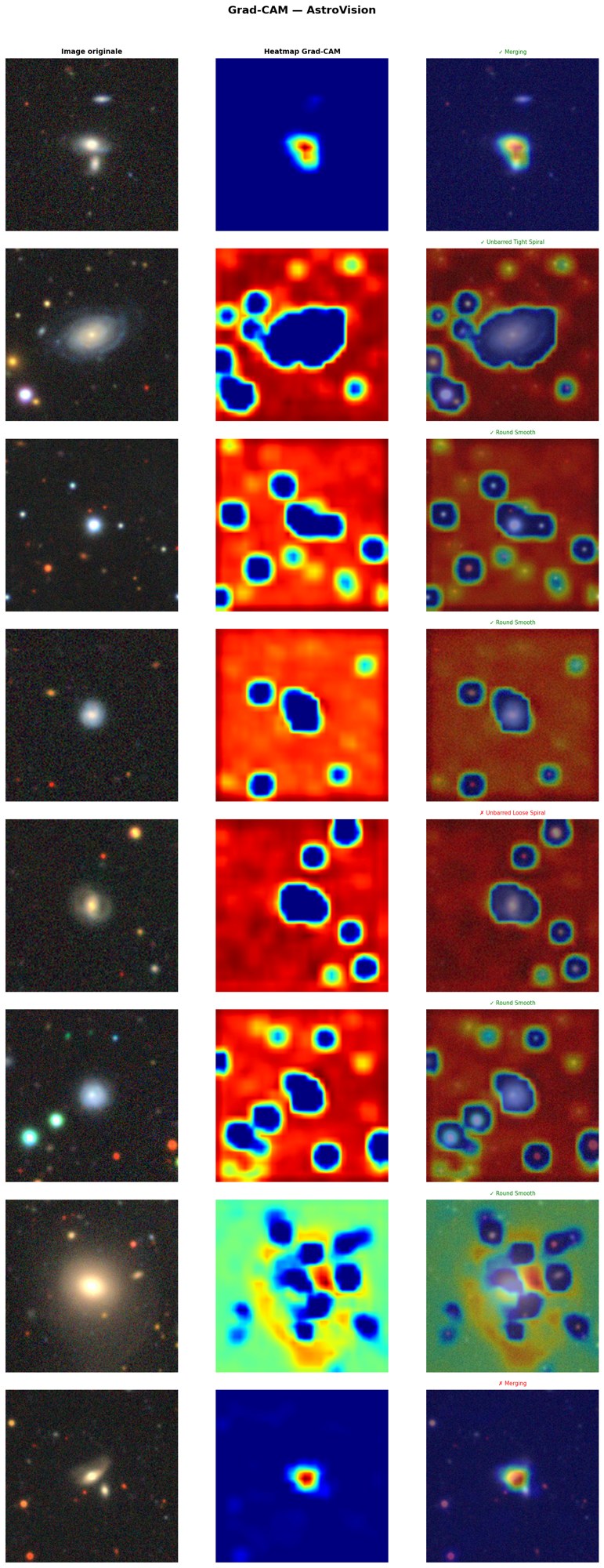
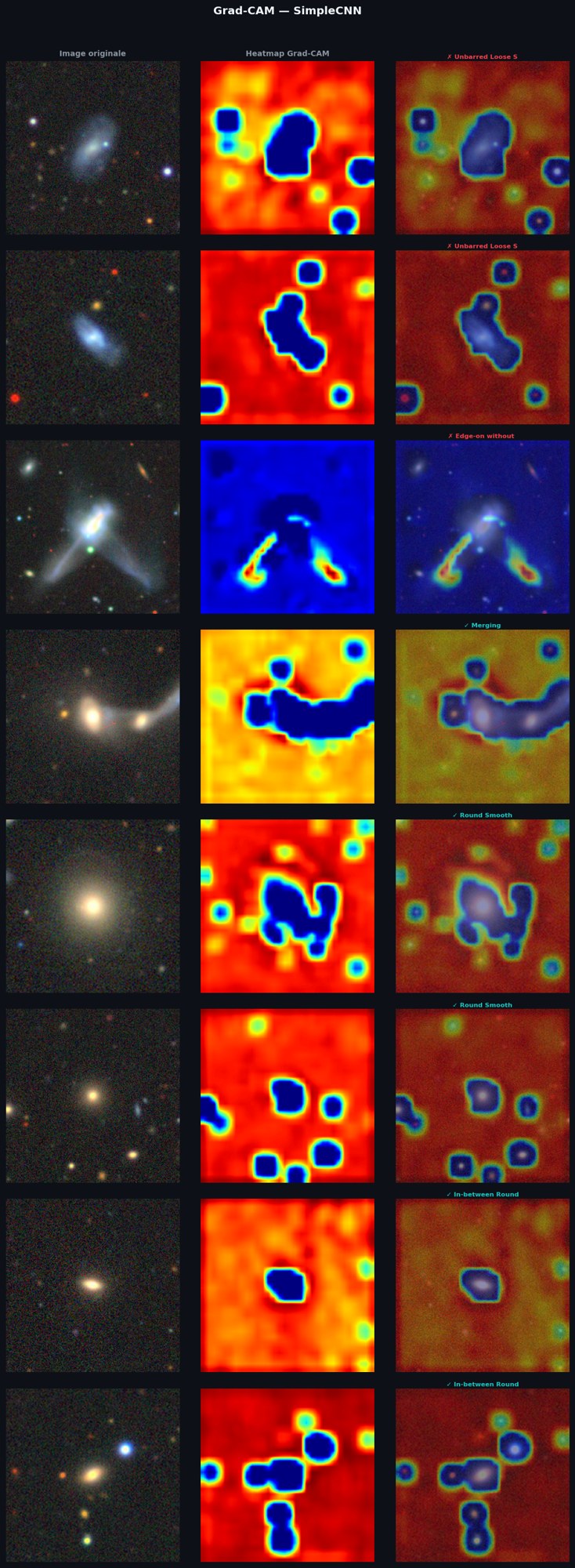
The Grad-CAM target layer (gradcam_target) is the 128→256 convolution before global pooling.
Training
Loss: cross-entropy with label smoothing 0.1; optimiser AdamW (weight decay 1e-4) with a cosine schedule (trainer.train). The notebook trains for 30 epochs at a learning rate of 1e-3; the recorded output is a final 5-epoch continuation at 1e-4 from an epoch-25 checkpoint, whose best validation balanced accuracy is 0.610. The best-validation checkpoint is kept.
Behaviour by class
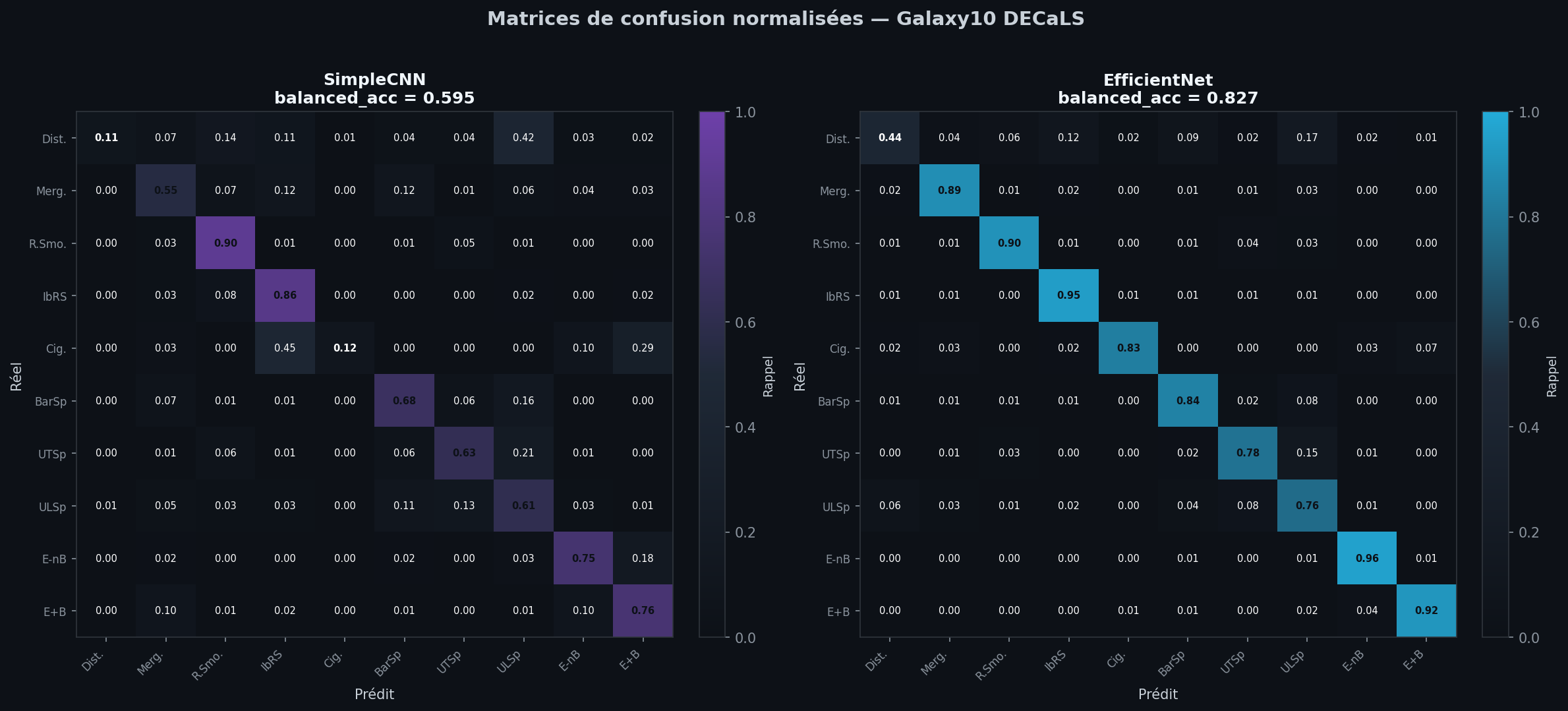
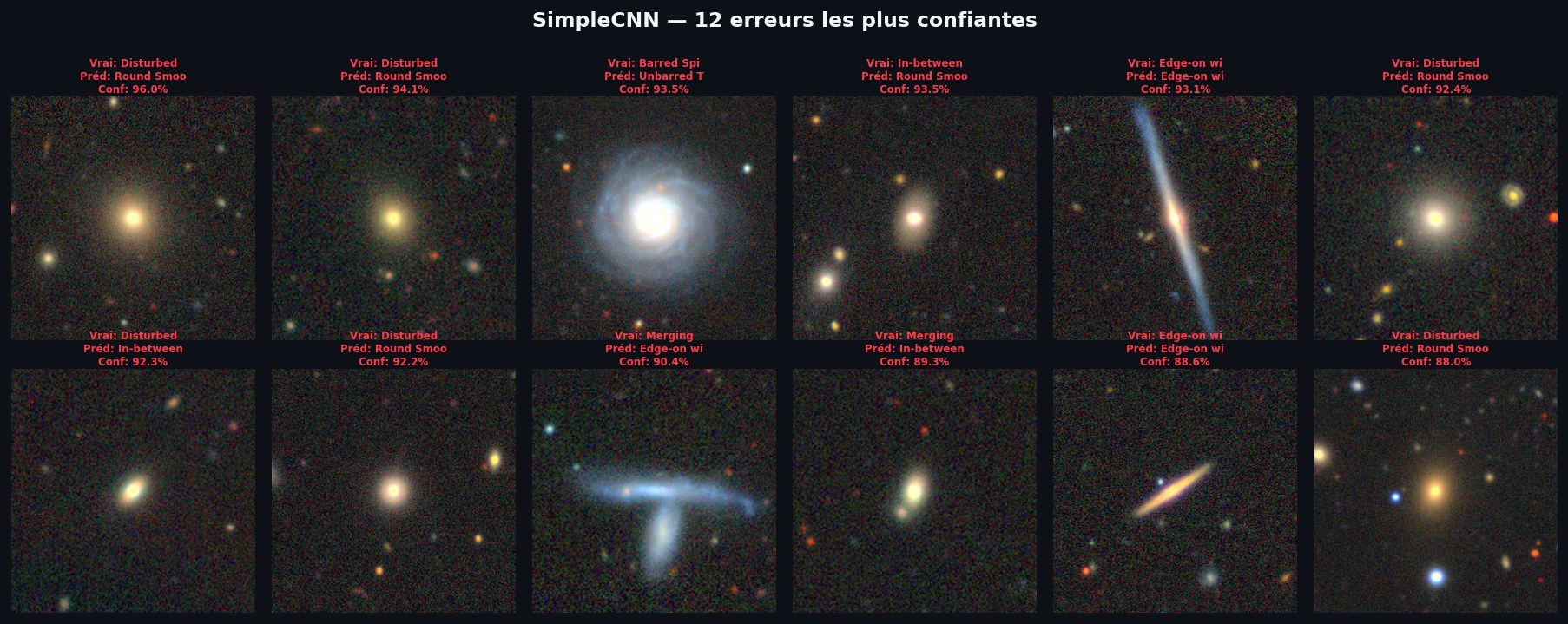
Smooth and edge-on classes are recognised well, but the model almost ignores two classes: Disturbed (recall 0.11) and Cigar Shaped Smooth (0.12) — the rarest classes. With 651k parameters trained on about 12,400 images, the network cannot learn the minority classes without class re-weighting.