Model Benchmarking
Overall comparison
| Model | Accuracy | Balanced acc. |
|---|---|---|
| Random baseline (10 balanced classes) | — | 10.0% |
| Majority class | 14.9% | 10.0% |
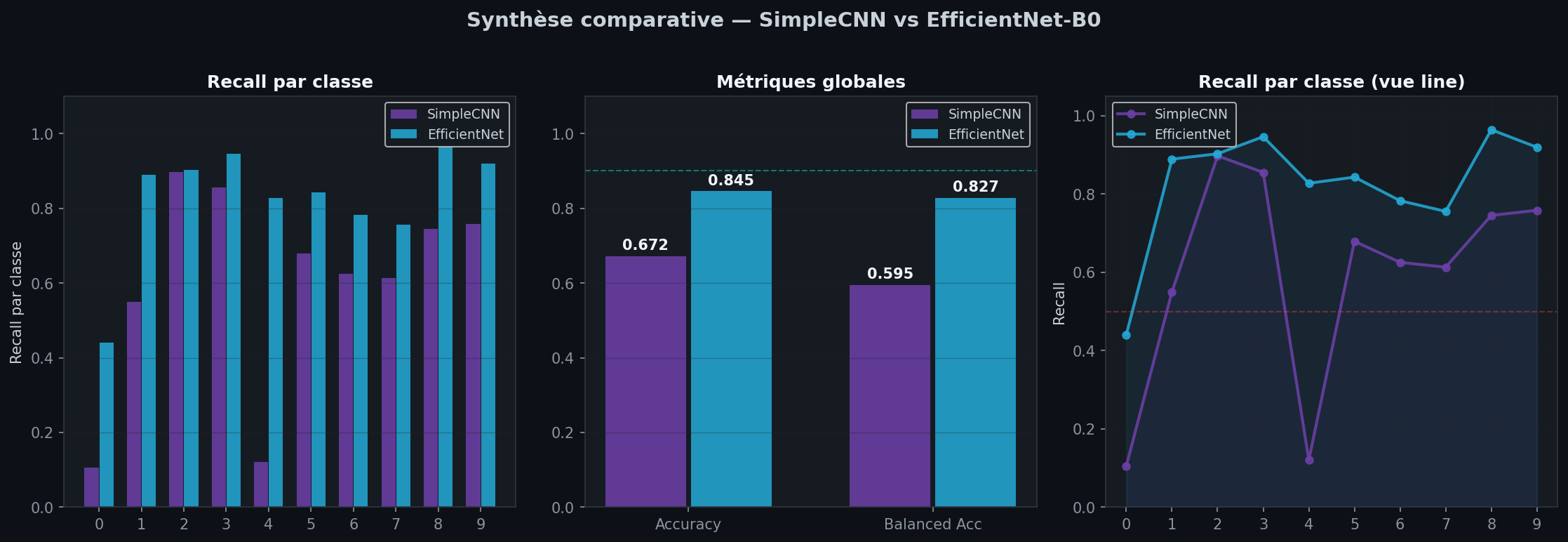
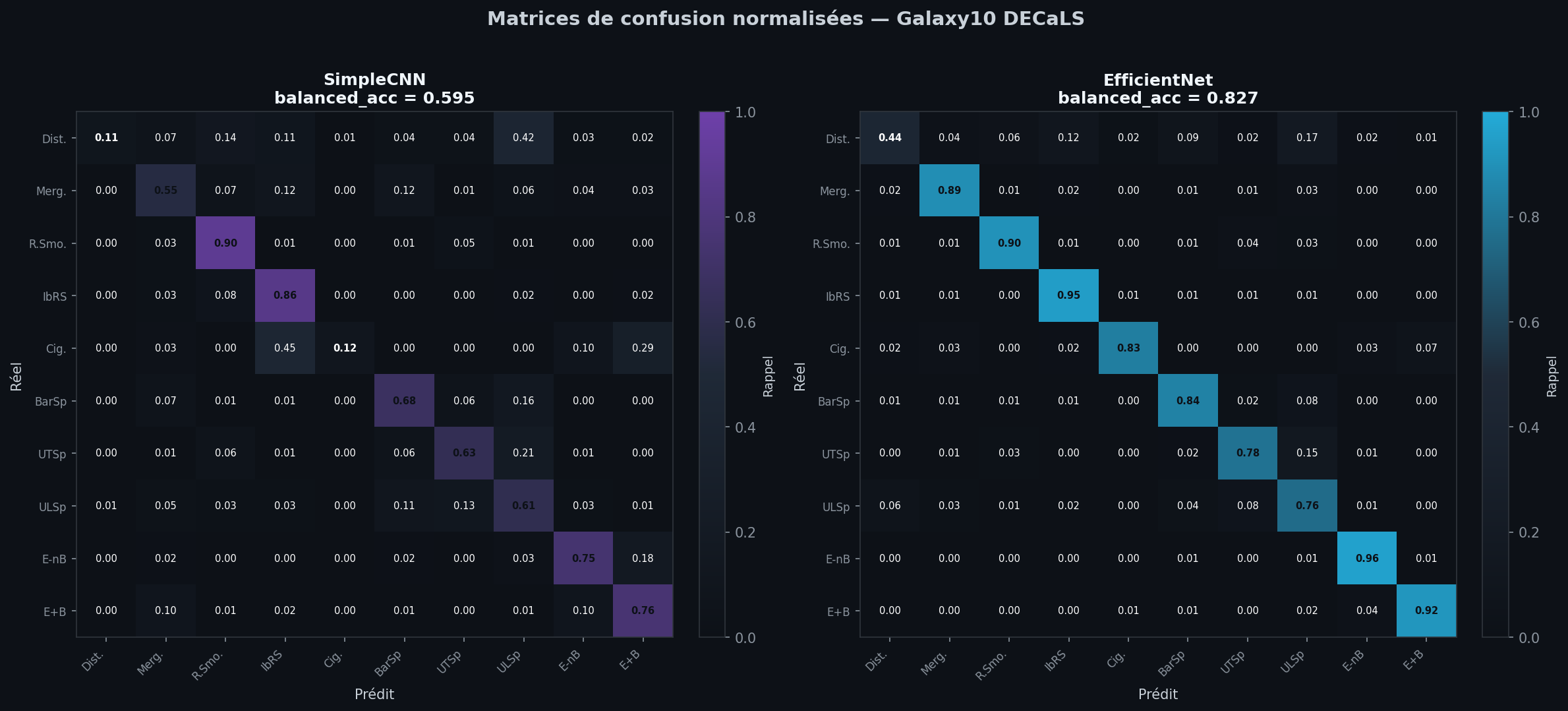
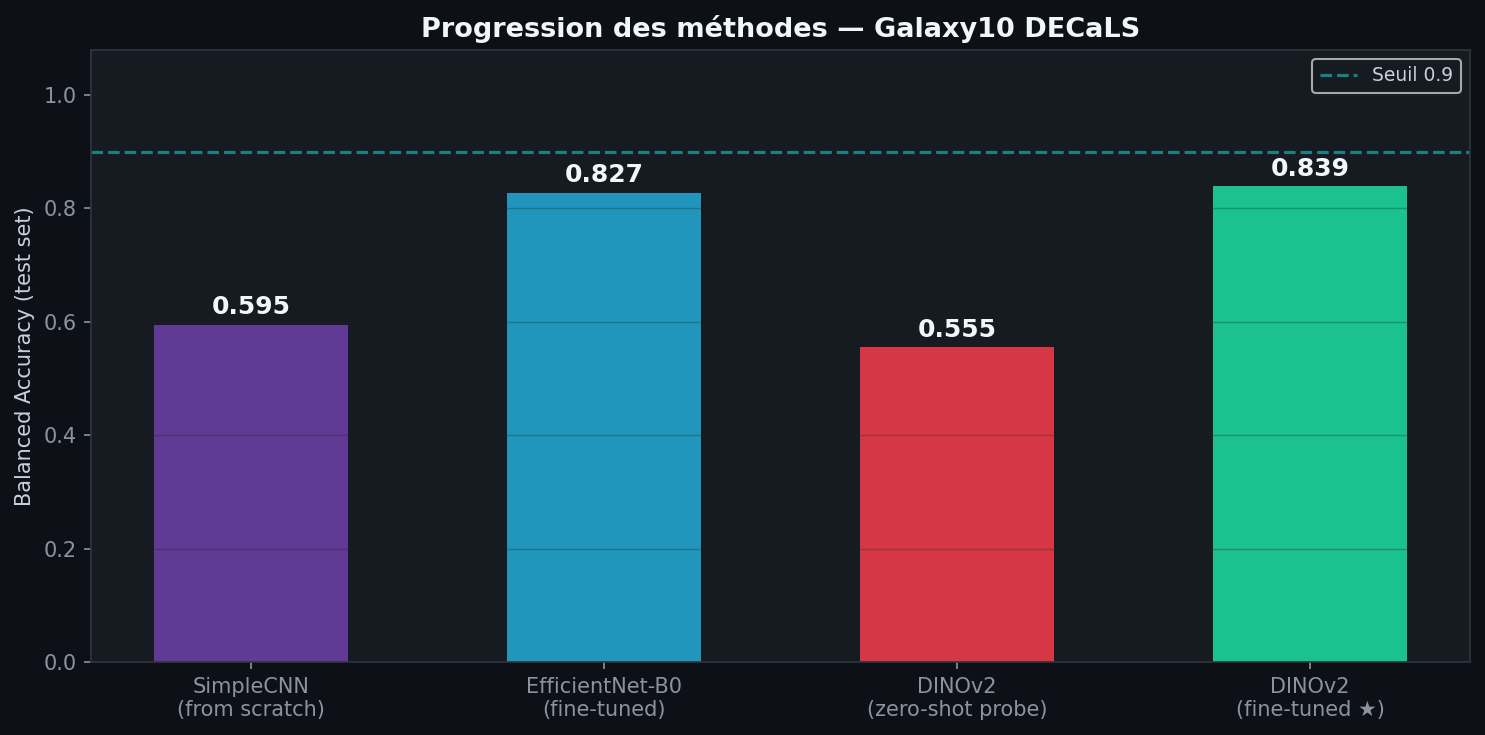
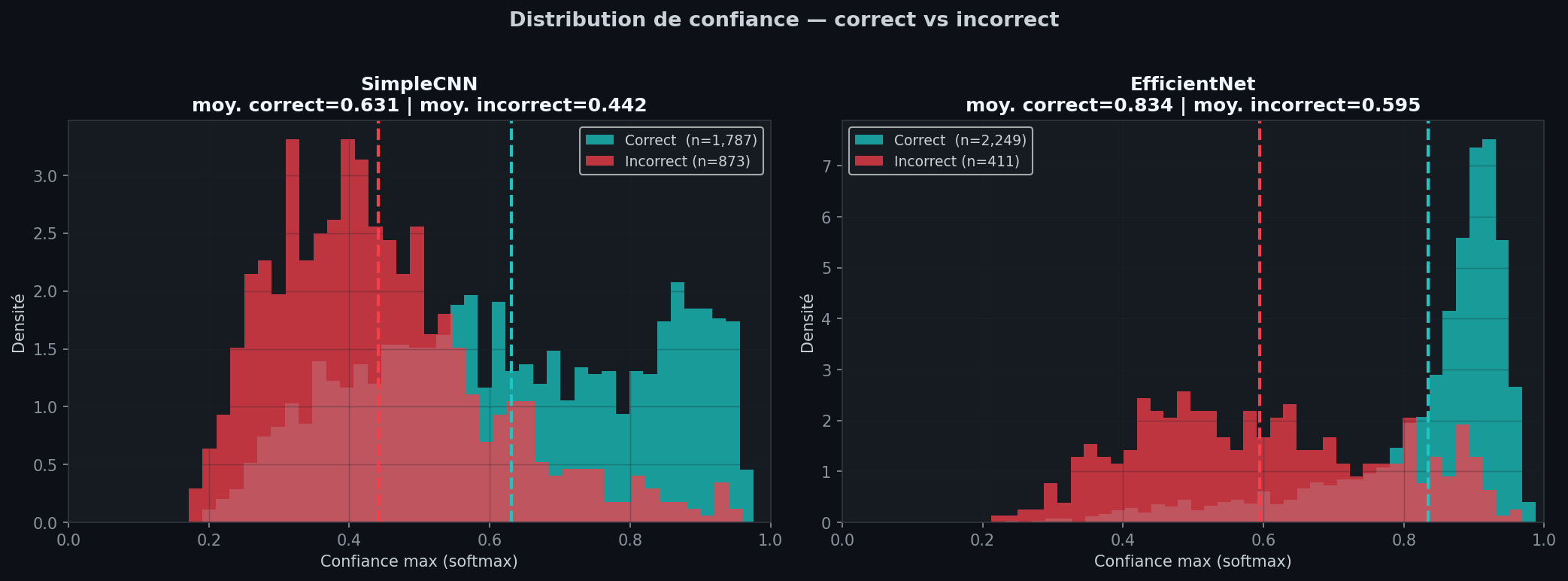
| SimpleCNN (scratch) | 67.2% | 59.5% |
| DINOv2 linear probe (frozen) | 63.6% | 55.5% |
| EfficientNet-B0 fine-tuned | 84.5% | 82.7% |
| DINOv2 ViT-B/14 fine-tuned | 86.5% | 83.9% |
| Fusion head (single run, other test split) | 87.5% | 86.3% |
Test sets: first four image models on the seed-42 random split (2,660 images); fusion on a stratified split (2,661 images).
Provenance. Model scores in this section are copied from the output cells of the AstroVision notebooks (and, for DINOv2 per-class recall, read from an exported figure). The documentation data pack contains no metrics file for them, so they cannot be re-derived from the pack; the cell of origin is listed for each value in
_facts/astrovision/FACTS_INDEX.md §3 and shown when hovering over a number.The progression is not monotonic with model size: the frozen 86 M-parameter DINOv2 (55.5%) is below a 0.65 M-parameter CNN (59.5%), and fine-tuning is what makes DINOv2 competitive. The margin of fine-tuned DINOv2 over EfficientNet-B0 is 83.9% against 82.7% — about one point, on about 2,660 test images and one training run each; it supports "comparable or slightly better", not a ranking.
Per class
| Class | SimpleCNN | EfficientNet-B0 | DINOv2 FT | Fusion |
|---|---|---|---|---|
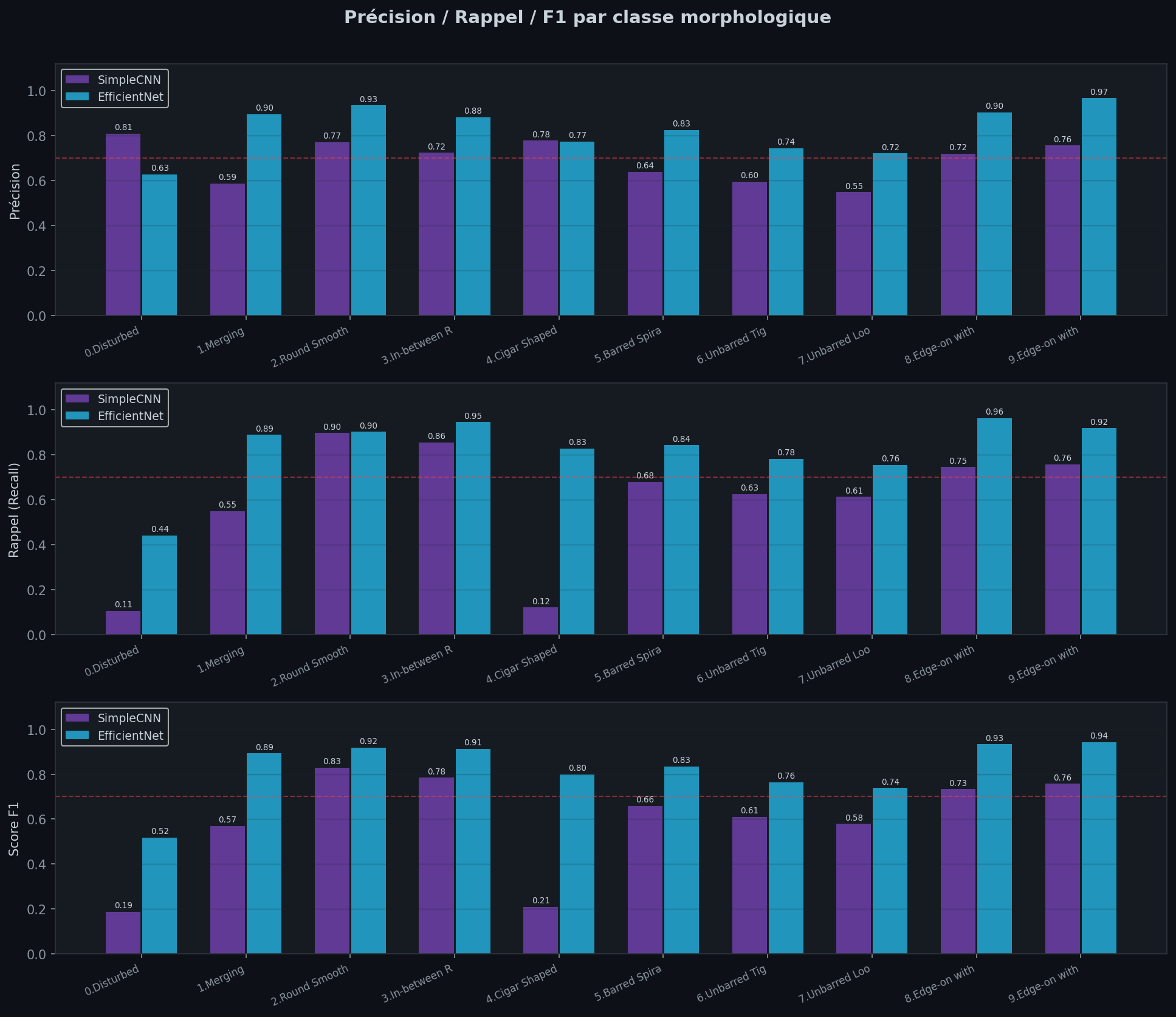
| 0 · Disturbed | 0.11 | 0.44 | 0.53 | 0.59 |
| 1 · Merging | 0.55 | 0.89 | 0.86 | 0.90 |
| 2 · Round Smooth | 0.90 | 0.90 | 0.94 | 0.95 |
| 3 · In-between Round Smooth | 0.85 | 0.95 | 0.95 | 0.91 |
| 4 · Cigar Shaped Smooth | 0.12 | 0.83 | 0.72 | 0.86 |
| 5 · Barred Spiral | 0.68 | 0.84 | 0.87 | 0.91 |
| 6 · Unbarred Tight Spiral | 0.63 | 0.78 | 0.83 | 0.83 |
| 7 · Unbarred Loose Spiral | 0.61 | 0.76 | 0.78 | 0.79 |
| 8 · Edge-on without Bulge | 0.75 | 0.96 | 0.96 | 0.93 |
| 9 · Edge-on with Bulge | 0.76 | 0.92 | 0.93 | 0.97 |
Recall on the test set. DINOv2 values are read from the exported confusion matrix (2 decimals).
Across models, the ordering of classes by difficulty is broadly stable: Disturbed is the hardest, followed by Cigar Shaped Smooth (for the CNNs), Unbarred Loose Spiral and Unbarred Tight Spiral; edge-on and smooth classes are easiest. Notably, adding modalities in the fusion model does not rescue Disturbed (recall 0.59).
How comparable are these numbers?
| Issue | Consequence |
|---|---|
| Two different test splits (2,660 random versus 2,661 stratified images) | Fusion versus the other models is an inter-split comparison |
| One training run per model; no seed repetition | Differences of 1–2 points are within plausible run-to-run variation (the fusion configuration scored 86.3% in one run and 85.7% in another) |
| Selection by validation balanced accuracy, reporting on test | Fine; but the validation curve of DINOv2 is noisy |
| Fusion features possibly from a backbone fine-tuned on part of its test set | Fusion score possibly optimistic (see Late-Fusion) |
Related pages