Feature Catalogue — 183 Spectroscopic Features
All features listed here are extracted in spectro_only=True mode.
Total: 183 features across 9 families.
Earlier documentation cited 174 features (FeatureEngineer output only).
The canonical count of 183 includes ~9 match_* columns added by ProcessingPipeline
during the line-matching step. See spectro_only=True Mode.
Feature families overview
| Family | Count | Physical domain | Example features |
|---|---|---|---|
| Balmer lines | ~25 | Temperature | Hα EW, Hβ prominence, Hγ FWHM |
| Ca II H&K | ~20 | Metallicity / activity | Ca II K EW, Ca II H prominence |
| Na / Mg / α-elements | ~15 | Chemistry / gravity | Na D EW, Mg b EW, Mg b prominence |
| Molecular bands | ~20 | Cool stars (T_eff < 4000 K) | TiO Δm, CaH index, MgH band |
| Fe & metals | ~25 | Metallicity | Fe I λ5270 EW, Fe I λ4668 |
| Continuum indices | ~30 | Temperature / gravity | B−V synthetic, fblue/fred, colour slopes |
| Line ratios | ~20 | Temperature / metallicity | Ca II K / Hβ, Fe / Mg |
| Line-profile moments | ~15 | Pressure / rotation | FWHM, asymmetry, kurtosis |
| match_* columns | ~13 | Line-matching (ProcessingPipeline) | match_CaIIH_prom, match_Hβ_EW |
Key features by SHAP importance
These features rank highest in the SHAP analysis on the canonical spectro_only=True run
(see SHAP Interpretability):
| SHAP rank | Feature name | Family | Physical interpretation |
|---|---|---|---|
| 1 | num_feature_CaIIK_prom | Ca II | Ca II K line prominence — metallicity proxy |
| 2 | num_feature_CaIIK_ew | Ca II | Ca II K equivalent width |
| 3 | num_feature_CaIIK_fwhm | Ca II | Ca II K line width (pressure broadening) |
| 4 | num_feature_CaIIH_prom | Ca II | Ca II H prominence |
| 5 | num_feature_CaIIH_ew | Ca II | Ca II H equivalent width |
| 6 | num_feature_Ha_ew | Balmer | H-alpha equivalent width |
| 7 | num_feature_Ha_prom | Balmer | H-alpha prominence |
| 8 | num_feature_Mgb_ew | Metals | Mg b equivalent width |
| 9 | num_feature_Mgb_prom | Metals | Mg b prominence |
| 10 | num_feature_Balmer_temp_index | Balmer | Combined Balmer temperature index |
Key features by PCA loading (PC1 — thermal axis)
These features contribute most to PC1 (ρ(PC1, T_eff) = +0.831):
| PC1 rank | Feature | Loading w | Interpretation |
|---|---|---|---|
| 1 | W(Hα) | +0.173 | Hα equivalent width — T_eff indicator |
| 2 | Continuum asymmetry | +0.172 | Blue/red slope |
| 3 | W(Mg b) | −0.171 | Mg b EW |
| 4 | Synthetic B−V | −0.163 | Colour temperature proxy |
| 5 | f_blue / f_red | +0.161 | Flux ratio |
Feature families in detail
Balmer series (Hα to Hθ)
Hydrogen Balmer absorption lines are the primary temperature indicators in stellar spectra. For each line, three measurements are extracted:
- EW (equivalent width): integrated line strength in Å
- Prominence: peak depth relative to local pseudo-continuum
- FWHM: full width at half maximum in Å
Features: Ha_ew, Ha_prom, Ha_fwhm, Hb_ew, Hb_prom, Hb_fwhm, ...
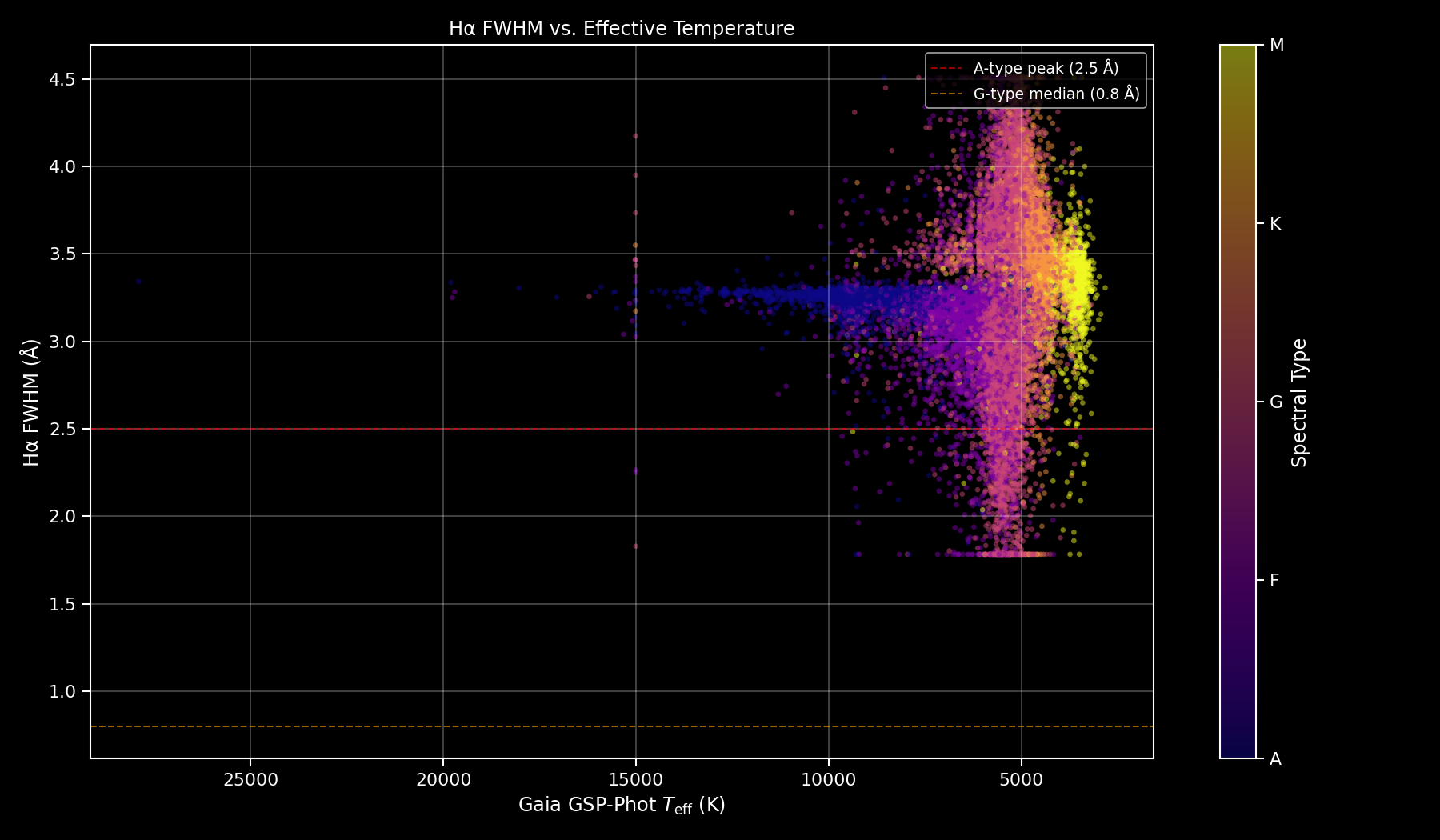
Hα FWHM vs Gaia DR3 T_eff — strong correlation confirming physical grounding
Ca II H&K doublet
Ca II H (3968 Å) and K (3933 Å) are the strongest lines in stellar optical spectra. They serve simultaneously as:
- Metallicity proxies (line strength ∝ Ca abundance)
- Chromospheric activity indicators (emission cores in active stars)
These are the top SHAP-ranked features in the canonical model.
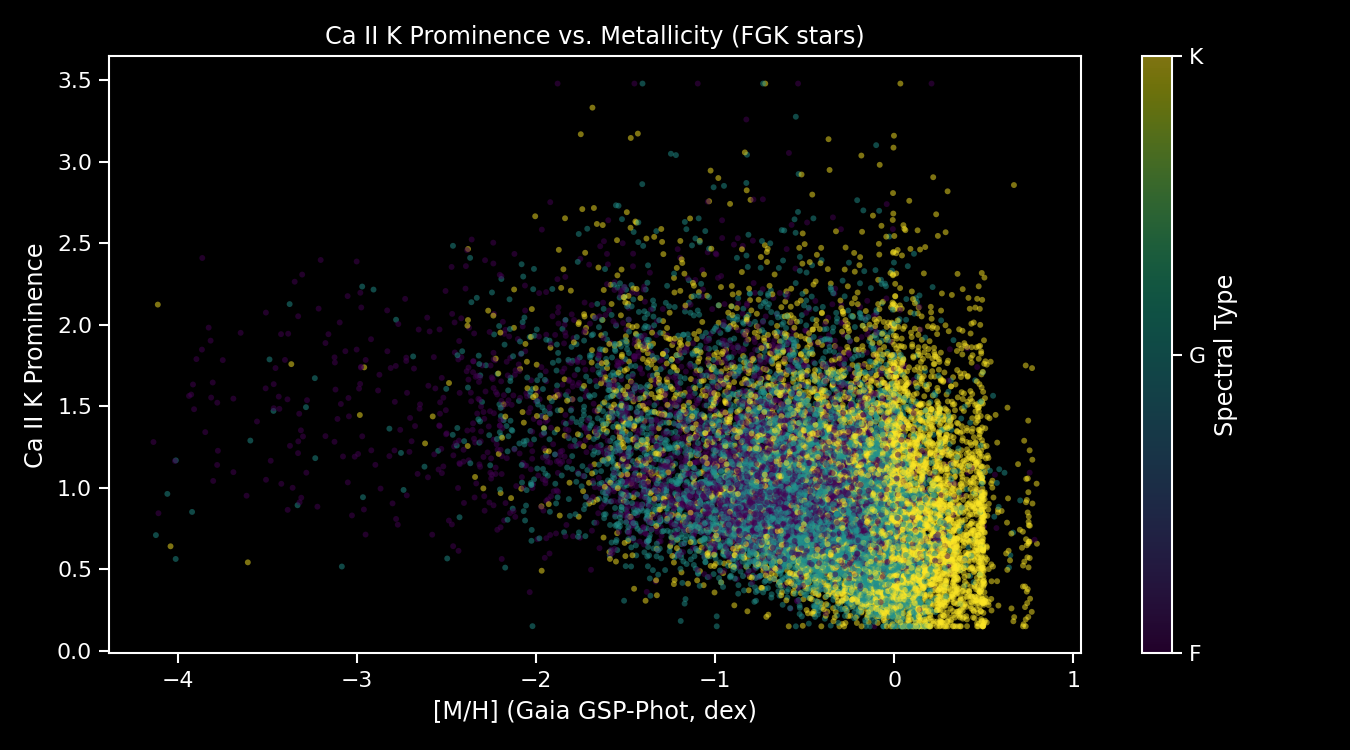
Ca II K prominence vs Gaia DR3 [Fe/H] — physical correlation between top SHAP feature and metallicity
Molecular bands (cool stars)
For T_eff < ~4,000 K, molecular absorption bands become the dominant spectral features:
| Band | Molecule | Wavelength range | Physical use |
|---|---|---|---|
| TiO | Titanium oxide | Multiple (5000–9000 Å) | Cool K-M stars |
| CaH | Calcium hydride | 6382–6389 Å | M subdwarfs vs giants |
| MgH | Magnesium hydride | 4780–4850 Å | Cool star gravity indicator |
| VO | Vanadium oxide | 7850–7860 Å | Very cool M stars |
SNR quality check
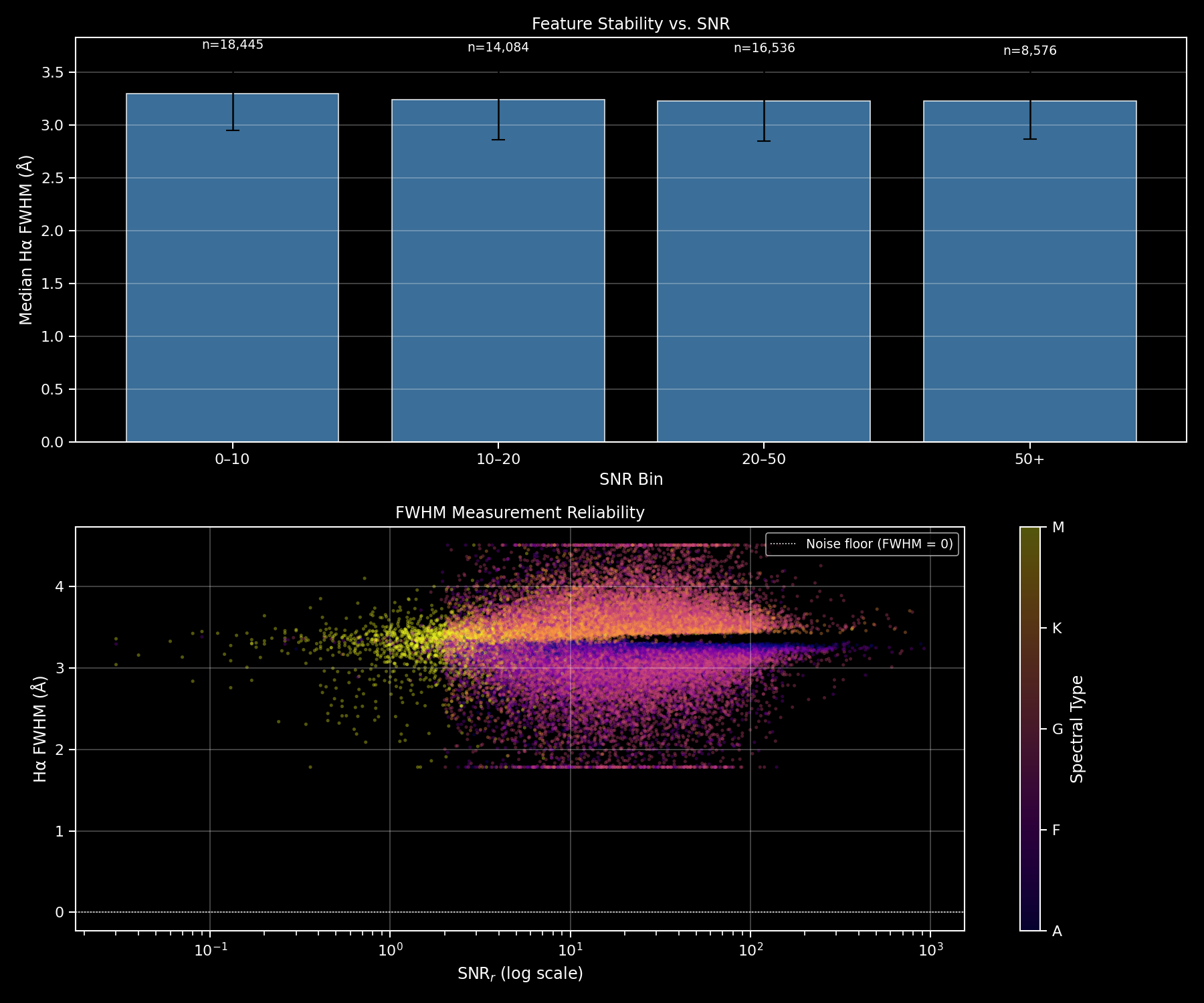
SNR distribution across the 43,019-spectrum dataset — quality filtering at SNR_g > threshold
Colour indices
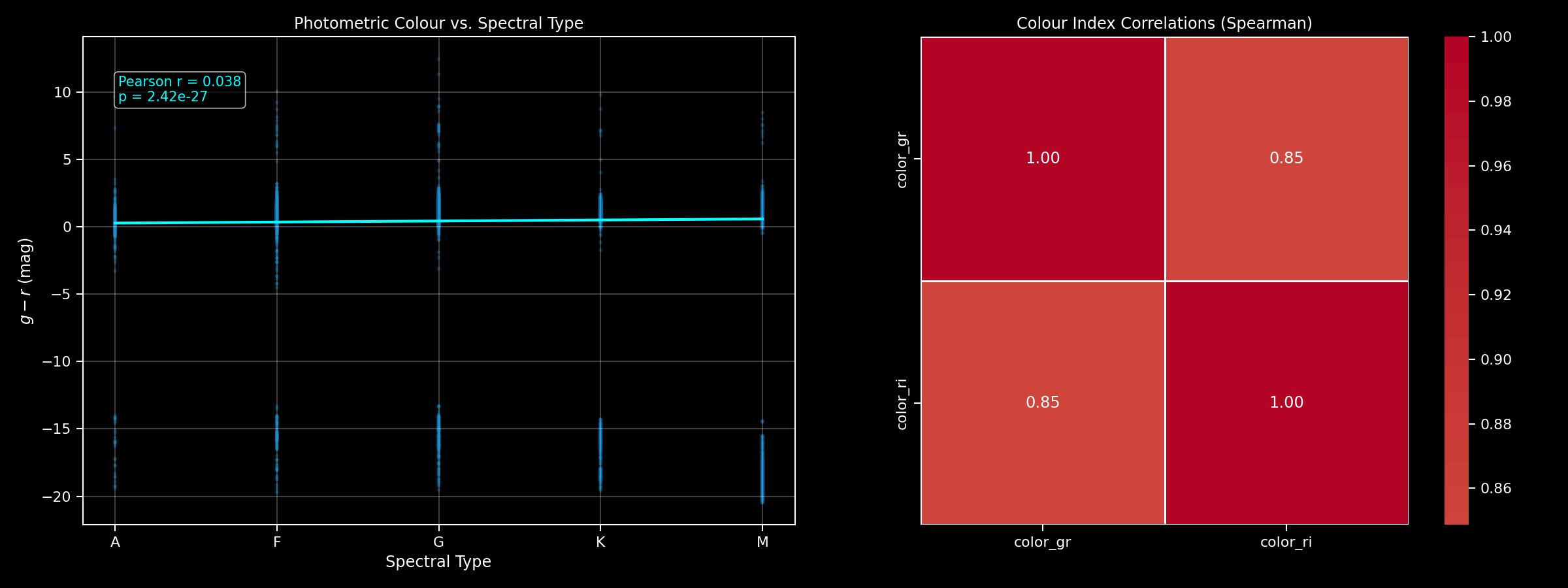
Synthetic colour indices (B−V, V−I, etc.) derived from the spectroscopic continuum
Column naming convention
num_feature_{line}_{measurement}

Examples:
  num_feature_CaIIK_ew       → Ca II K equivalent width
  num_feature_Ha_fwhm        → Hα full width at half maximum
  num_feature_Mgb_prom       → Mg b prominence
  num_feature_Balmer_temp_index → combined Balmer temperature index
  match_CaIIH_prom           → Ca II H match from ProcessingPipeline
See also
- spectro_only=True Mode — which features are included/excluded
- Physical Purity & Leakage — why non-physical features are excluded
- Feature Engineering — how features are computed
- SHAP Interpretability — feature importance analysis
- PCA — Physical Interpretation — PCA loadings by feature family