Ξosc Oscillation Diagnostic
This page analyses the oscillation amplitude ε of the Ξosc model on Pantheon+SH0ES + DESI DR2 BAO. The amplitude is the parameter that decides whether an oscillation is needed at all, so it is the project's central diagnostic — and the one most easily over-read.
ε/σε ≈ 2.26 is a descriptive ratio computed under a one-sided, bounded prior. The project does not claim to detect oscillating dark energy.
Key results
| Quantity | Value | Context |
|---|---|---|
| ε (median) | 0.1847 | Ξosc, final run |
| 16–84% offsets | +0.0768 / −0.0867 | asymmetric |
| σε (symmetrised) | 0.0818 | ½(plus + minus) |
| ε / σε | 2.26 | descriptive |
| Prior on ε | 0 < ε < 0.3 | uniform, one-sided |
| T | 5.47 (+3.60, −2.22) Gyr | prior 1–10 Gyr |
| φ₀ | −0.09 (+2.46, −2.38) rad | prior −π to π |
What the amplitude says
Result. The posterior median of ε is non-zero and its 16–84% interval excludes zero (lower edge: ε − σ₋ = 0.185 − 0.087).
Interpretation. The combined data allow an oscillatory component and give Ξosc the lowest raw χ² of the three models. The preference does not survive the complexity penalty: CPL keeps the lowest AIC and BIC (Model Comparison).
Caveats — why ε/σ is not a significance.
- One-sided prior. ε is restricted to 0 < ε < 0.3. A posterior on a half-line cannot be summarised by a Gaussian σ: part of the apparent offset from zero is the boundary itself.
- The posterior reaches the upper bound. In the corner plot the ε marginal stays high up to the prior's upper edge; the upper 1σ edge (0.262) is not far from it. The inferred amplitude is therefore partly set by the prior range, not only by the data.
- ε = 0 is not ΛCDM. At ε = 0 the model is a constant-w model, not w = −1 (Three Model Families).
- Asymmetric interval. The symmetrised σ averages an upper offset of 0.077 and a lower one of 0.087.
Period and phase are weakly constrained
T has a multi-featured posterior that reaches its upper prior edge, and φ₀ is nearly unconstrained over its periodic range. The autocorrelation times of these two parameters are also the longest of the model (Convergence Diagnostics). The medians of T and φ₀ in the table above are summaries of broad distributions, not best-fit values.
Reconstructed w(z)
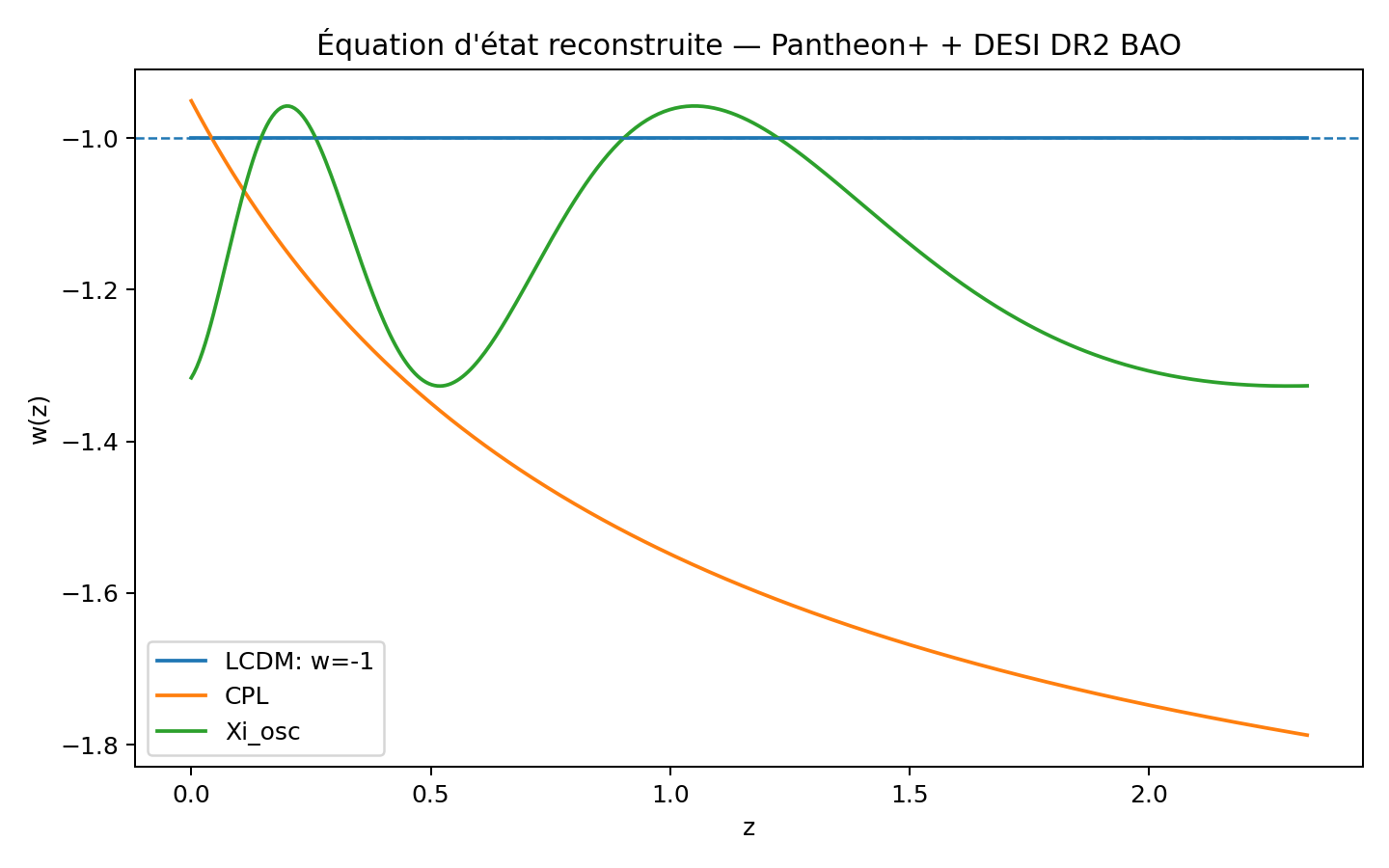
Figure 1 — w(z) for ΛCDM (constant), CPL (monotonic) and Ξosc (oscillating), each drawn with the posterior medians of its parameters.
The Ξosc curve is evaluated at the median of each parameter. For a multi-featured posterior in T and φ₀ the median combination need not correspond to a high-probability curve, and the oscillation phase today (hence w at z = 0) depends on it. The figure illustrates the form of the model; it is not a reconstruction with uncertainty bands.
Planned checks
The Roadmap lists the tests that would settle how much of the amplitude preference is prior-driven: a symmetric prior on ε, a wider and a logarithmic prior on T, and a time variable defined consistently with the sampled cosmology.